
There is a haircut that gives you movement, softness and that just-left-the-salon feeling without asking you to give up a single inch of length, and this winter it is everywhere. The winter haircut ideas for women with a long shag and curtain bangs in this guide are built around one simple promise: you keep your length, and the layers do all the work. If you have ever looked at a shag and thought it was only for short hair, this is the version that will change your mind.
A long shag with curtain bangs is the haircut for women who want movement without losing length. It is the cut you ask for when your hair feels heavy and flat, when your ends look tired, and when you want to walk out of the salon looking like yourself, only better. The layers start at the cheekbone, the curtain bangs blend straight into those layers, and suddenly your hair has a shape again. It swings when you walk. It holds a wave. It looks good on day one and on day four.
In this guide you will find 21 winter haircut ideas for women with a long shag and curtain bangs, plus honest advice on what the cut actually is, how the face frame works, how it behaves on straight and wavy hair, how to style it when you air-dry and when you blow it out, and how to grow it out without that awkward in-between stage. Save the looks you love, show them to your hairdresser, and get ready for the easiest good-hair winter you have had in years.

What a Long Shag Actually Is
A long shag is a layered haircut, but the layers are doing a very specific job. Instead of one heavy sheet of hair that hangs in a straight line, a long shag is cut with shorter pieces through the top and sides that graduate into longer lengths at the bottom. The result is a shape that is full at the crown, soft around the face, and light at the ends. It is the opposite of a blunt cut: nothing about it is a hard line. If you run your fingers through it, the hair falls back into place in pieces, and that is exactly the point.
The winter version of the long shag is a little softer than the rock-and-roll shags of the past. The layers are blended, the ends are textured rather than spiky, and the whole cut is designed to work with a coat, a scarf and a wool hat. It is also a wonderfully forgiving cut. If you are growing your hair out, a long shag hides the awkward stages. If your hair is fine, the layers give it lift. If your hair is thick, the layers take out the weight. And if you love the idea of bangs but are scared of commitment, the curtain bangs in this guide are the gentle way in, because they grow out into face-framing layers instead of a blunt fringe you have to maintain every three weeks. For a shorter take on the same idea, see our guide to shag bob hairstyles for women this winter.
The Cheekbone Layers That Make It a Shag
Every good long shag starts at the cheekbone. That is where the shortest layer sits, and it is the layer that decides whether the cut looks like a shag or just like long hair with a few layers in it. Ask your hairdresser to start the layers at your cheekbones and to cut them so they curve gently toward your face. When that layer is right, it does three things at once: it opens up your face, it gives the hair around your face movement, and it creates the shelf that the rest of the layers fall from.
Here is a practical example. If you have a round face, ask for cheekbone layers that are a touch longer, sitting just below the cheekbone, so they lengthen rather than widen. If you have a long face, cheekbone layers that are a little shorter and fuller will add width exactly where you want it. And if you wear glasses, tell your hairdresser: the shortest layer should sit above or below your frames, not right on top of them, or the hair will fight your glasses all day. Bring a photo of the exact layer length you want, and point to your own cheekbone in the mirror while you talk about it. Hairdressers love that, because it removes all the guesswork.

The Soft, Lived-In Length
The second half of the long shag is the length, and the rule here is simple: the ends should look lived in, not finished. A good long shag is cut so the bottom two or three inches are textured, which means the hairdresser removes a little weight from the ends instead of cutting them in a straight line. That is what stops the cut from looking heavy in winter, when your hair is under a coat collar and a scarf for half the day, and it is what makes the hair move when you turn your head.
Try this at home to see the difference. On a day when your hair is clean and dry, gather the bottom of your hair in your hand and look at the ends. If they form one solid line, your cut is blunt. If they fall in soft, separate pieces, you have a shag. To keep that lived-in feeling between appointments, skip the heavy smoothing serum on the ends and use a pea-sized amount of lightweight hair oil instead, warmed between your palms and pressed into the bottom inch only. And when you sleep, a loose low braid will keep the layers from tangling overnight without flattening them, which is a small winter habit that makes a big difference by morning.

Long Shag With Curtain Bangs: The Face Frame
Curtain bangs are the reason this whole cut works so well, and they are also the part most people get wrong. A curtain bang is not a straight-across fringe. It is parted in the middle and cut so it is shortest at the centre and longer at the sides, falling like a curtain on either side of your face. In a long shag, those bangs are not a separate feature: they are the top layer of the cut, and they blend straight into the cheekbone layers. That is what makes the whole thing look soft instead of severe, and it is why curtain bangs suit almost every face shape.
The other reason curtain bangs are so popular this winter is that they are low-maintenance in a way a blunt fringe never is. They grow out gracefully, they can be pushed to the side on a bad hair day, and they look good both straight and wavy. If you have never had bangs before, start here. Ask for them long, at the cheekbone or even the jaw, and live with them for a month. You can always go shorter at your next appointment, but you cannot glue hair back on, and a long curtain bang is the safest first step you will ever take.
The Classic Curtain Bangs That Blend Into the Layers
The classic version is the one you have seen all over your feed: a centre part, bangs that hit the cheekbone at their longest point, and layers that carry the line down past the shoulders. This is the look to ask for if you want the full long shag effect, because the bangs and the layers read as one continuous shape. It works beautifully on straight hair, where the line of the bang is clean, and on wavy hair, where the ends flick out a little and make the whole thing look effortless.
Styling it is simpler than it looks. After washing, part your hair in the middle while it is still damp, then take a round brush and blow-dry each side of the bangs away from your face, rolling the brush outward as you go. That outward roll is the whole trick: it is what gives curtain bangs their signature sweep instead of letting them fall flat on your forehead. Finish with a light mist of flexible hairspray, not a strong-hold one, so the bangs can still move. And on the days you do not wash your hair, a quick blast of dry shampoo at the roots will lift the bangs back into place in about thirty seconds.

Wispy Curtain Bangs for a Softer Frame
If the classic curtain bang feels like too much hair on your face, the wispy version is your answer. Wispy curtain bangs are cut with less density, so you can see a little forehead through them, and they feel lighter around the eyes. They are a wonderful choice for fine hair, because a heavy bang can eat up the hair you have, and they are also the best choice if you wear your hair up a lot: a few wispy pieces falling out of a ponytail or a bun look intentional instead of messy.
Here is how to wear them in real life. On a workday, pair wispy curtain bangs with a low, loose ponytail and let two thin pieces frame your face; it takes two minutes and looks like you tried for twenty. On a cold weekend, wear them under a beanie with the bangs pulled forward, and they will keep your face from looking washed out by the hat. And if your bangs start to look stringy by the afternoon, which happens to everyone in winter, run a tiny bit of texturising spray through them with your fingers instead of brushing them: brushing makes wispy bangs go flat, while your fingers keep the separation that makes them look soft.

Long Curtain Bangs You Can Tuck Behind Your Ears
Long curtain bangs are the most practical version of all, and they are the one I recommend to anyone who is on the fence. Cut to the jaw or even the chin, they frame your face when you wear your hair down, and they disappear behind your ears when you want them gone. They are also the bangs that survive the grow-out best, because at a certain point they simply become the shortest layer of your long shag, and nobody can tell where the bangs end and the layers begin.
This length is especially good if you have thick hair, because a shorter bang on thick hair can puff up and take over your whole face. A longer, heavier curtain bang has the weight to sit properly. Ask your hairdresser to thin the very ends of the bangs with point cutting, which is a technique where the scissors cut into the ends at an angle, so the line is soft rather than blunt. And here is a small habit that will save you: keep a pair of small hair clips in your bag. On a windy winter day, clip the bangs back for the walk to the office and let them down when you arrive. Your hair will look freshly styled instead of wind-blown, and nobody will ever know.

Long Shag for Straight vs Wavy Hair
The long shag is one of the rare cuts that works on almost every hair type, but it does not look the same on all of them, and knowing what to expect will save you from disappointment. On straight hair, the layers are the star: they create the movement that straight hair often lacks, and the shape is clean and graphic. On wavy hair, the texture is the star: the layers encourage your natural wave, and the cut looks softer and more undone. Neither is better. They are just different, and the right version depends on your hair and on how much effort you want to put in on a weekday morning.
The Sleek Straight Long Shag
On straight hair, a long shag looks polished in a way that surprises people. The layers fall in clean, separate pieces, the curtain bangs frame the face in a smooth sweep, and the whole cut has a nineties-supermodel feeling that works beautifully in winter, when sleek hair looks especially expensive against a wool coat. The trick is to keep the layers long enough that they do not flip out at the ends: ask your hairdresser to keep the shortest layer at the cheekbone and to blend the rest, rather than cutting short, choppy pieces through the top.
For a real-life example, think about a day at the office. Wash your hair the night before, blow-dry it smooth with a paddle brush, and sleep on a silk pillowcase. In the morning, run a flat iron over just the very ends, curving them slightly inward, and the cut will look like you spent forty minutes on it. If your straight hair tends to go flat by lunchtime, a quick spritz of volumising spray at the roots and a shake of the layers will bring the shape back without a full restyle. And do not skip the heat protectant: sleek straight hair shows damage faster than wavy hair does, and winter heating makes it worse.

The Wavy, Air-Dried Long Shag
If your hair has a natural wave, the long shag was made for you. The layers remove the weight that pulls waves flat, so your wave pattern can actually show, and the cut looks good with almost no styling at all. This is the version to ask for if you want wash-and-go hair in winter: wash, scrunch in a little curl cream, let it air-dry, and go. The waves will fall in different directions, the bangs will have a soft bend, and the whole thing will look like you tried very hard when you did almost nothing.
A practical tip: the way you dry your waves matters more than the products you use. After washing, gently squeeze the water out with a microfibre towel or an old cotton T-shirt, never a rough bath towel, which creates frizz. Then apply a small amount of curl cream to the mid-lengths and ends, scrunch upwards, and do not touch your hair again until it is completely dry. Touching it while it dries breaks the wave pattern and creates frizz, which is the single most common reason a wavy shag looks messy instead of undone. Once it is dry, shake the roots with your fingers and you are done.

The Soft Curls at the Ends
Some long shags are finished with soft curls at the ends, and this is the version that photographs best. The curls do not have to be perfect ringlets: the look is a loose, brushed-out bend through the bottom third of the hair, which makes the layers look fuller and the whole cut look more finished. It is a lovely choice for a winter party or a family gathering, because it reads as dressed-up without being stiff, and it holds up well under a coat and a scarf.
To get it at home, use a large-barrel curling iron or a round brush and a hairdryer, and curl only the bottom half of your hair, leaving the roots straight. Wrap each section away from your face, hold it for five seconds, and let it cool in your hand for a few seconds before you let it drop: that cooling time is what makes the curl last. When you have curled everything, run your fingers through it once, gently, to break the curls into soft waves. A light flexible-hold spray will keep the shape without making it crunchy, and if one side falls flat during the evening, just re-curl the two front sections: nobody will ever notice the back.

Styling a Long Shag: Air-Dry vs Blowout
Here is the honest truth about styling a long shag: it is one of the easiest cuts to style, because the cut does most of the work for you. But air-drying and blow-drying give you two very different looks, and it helps to know which one you are getting before you start. Air-drying gives you texture, movement and a relaxed finish. A blowout gives you polish, volume and a shape that lasts for days. Most women who love this cut use both, depending on the day, and the cut is forgiving enough to handle either.
The Five-Minute Air-Dry
The air-dry is the long shag’s party trick, and it is the reason so many busy women choose this cut. Wash your hair, towel-dry it gently, and work a small amount of leave-in conditioner through the mid-lengths and ends. Then add a pea-sized amount of texturising cream or a salt spray, scrunch the layers upwards with your hands, and let the air do the rest. If you want a little more shape around your face, twist the two front sections away from your face while they are damp and let them dry in that twist: when you release them, they will fall in a soft wave that frames your face perfectly.
Winter makes air-drying trickier, because nobody wants to leave the house with wet hair in January. The fix is to wash your hair earlier in the evening, let it dry most of the way while you are at home, and then finish it with thirty seconds of cool air from the hairdryer, aimed at the roots. That gives you the texture of an air-dry with the comfort of dry hair. And if your hair dries with a kink where your scarf sat, just dampen that one section with water, smooth it with your fingers, and it will settle in a minute.

The Bouncy Blowout
A blowout is the long shag at its most glamorous, and it is easier than it looks once you know the order of operations. Start with a heat protectant and a volumising mousse at the roots. Rough-dry your hair until it is about eighty percent dry, using your fingers and the dryer, and then switch to a large round brush for the final twenty percent. Work in sections, rolling the brush away from your face at the front and under at the ends, and finish each section with a blast of cool air, which sets the shape. The whole thing takes about fifteen minutes once you have done it twice.
The most common mistake is blow-drying the bangs last, when they have already dried in the wrong direction. Dry the curtain bangs first, while they are still damp, rolling them away from your face with a round brush. That sets the sweep, and the rest of the hair can follow. If you want the blowout to last into a second day, sleep with your hair in a loose topknot on a silk scrunchie, and in the morning, shake it out and add a little dry shampoo at the crown. It will not look as perfect as day one, but it will look very good, and that is usually enough.

The Second-Day Refresh
Second-day hair is where a long shag really earns its keep, because the layers hide the fact that you did not wash your hair. The refresh takes three minutes. Start with dry shampoo at the roots, focusing on the crown and the bangs, and let it sit for a minute before you brush it through: that waiting time is what lets it absorb the oil. Then mist the mid-lengths lightly with water, scrunch the layers back into shape with your hands, and smooth the very ends with a tiny bit of hair oil.
If the ends look dry or flyaway, which they often do in winter, that is usually a sign they need moisture, not more styling. Once a week, treat the bottom half of your hair to a deep conditioning mask and leave it on for ten minutes while you do everything else in the shower. Rinse it out with cool water, which helps the hair cuticle lie flat and makes the hair look shinier. And if your bangs are the problem, remember you can always clip them back with two small clips, let the layers do the talking, and call it a look. Nobody will know it was a rescue mission.

Growing Out a Long Shag
Growing out a long shag is easier than growing out almost any other cut, because the cut is already built on layers. There is no single blunt line to grow through, and the curtain bangs simply turn into face-framing layers as they get longer. The awkward stage that scares most people barely exists here, which is one more reason this cut is such a good winter choice: you can start it now and still love it in spring.
Keeping the Shape While It Grows
The secret to a good grow-out is to keep trimming the ends while you let the top layers catch up. Book a dusting, which is a tiny trim of just the very ends, every eight to ten weeks. It sounds backwards to cut your hair while you are growing it, but it keeps the ends healthy, and healthy ends are what make long hair look long. Between appointments, use a wide-tooth comb on wet hair instead of a brush, and keep your hair tied loosely at night. A tight ponytail every night will break the layers at the same spot and create a line you do not want.

When to Trim and When to Wait
Trim when the ends start to look thin or see-through, when your hair tangles at the bottom no matter what you do, or when the layers stop falling into place. Wait when the cut still has its shape and the ends still feel full. A simple test: hold a section of hair up to the light. If the last inch looks wispy and pale compared with the rest, it is time for a trim. If it looks solid, you can wait another month. And when you do go in, bring a photo of where you are heading, not just where you are now, so your hairdresser can shape the cut toward your goal instead of just maintaining it. A good grow-out is a plan, not an accident, and your hairdresser is your partner in it.

Frequently Asked Questions About the Long Shag
How often should you trim a long shag? Every eight to twelve weeks is right for most people. The layers need a light refresh to keep their shape, and the ends need a dusting to stay healthy. If your hair grows fast, go every eight weeks; if it grows slowly, twelve is fine.
Will a long shag work with fine hair? Yes, and it is one of the best cuts for fine hair, because the layers create lift and movement that fine hair often lacks. Ask for longer layers rather than short, choppy ones, and use a volumising mousse at the roots. Avoid heavy oils, which will weigh fine hair down.
Can I get a long shag with curtain bangs if my hair is curly? You can, but ask for a dry cut, where the hairdresser cuts your hair while it is dry and in its natural curl pattern. Cutting curly hair wet is risky, because it springs up as it dries. A dry cut lets your hairdresser see exactly where each layer will fall.
Save This Look for Later
Love this long shag with curtain bangs? Save the pin below so you can find it again when you book your appointment.
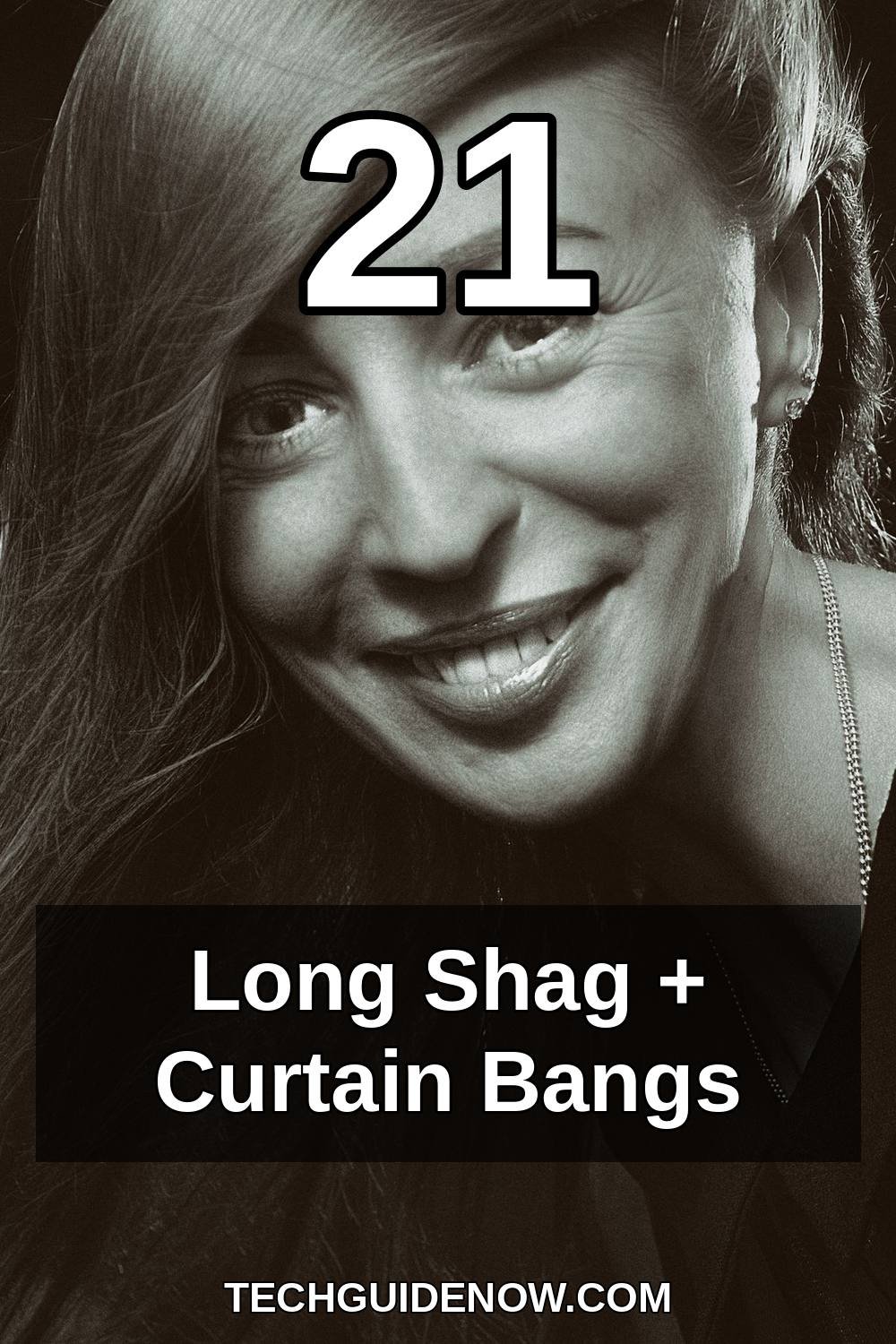

Want a caption for your own pin? Try our free Pinterest Caption & Pin Generator to create a caption for your long shag look in seconds.
Final Thoughts: Save This Guide for Your Hairdresser
The long shag with curtain bangs is the winter haircut for women who want to look like they put in effort without actually putting in effort. It keeps your length, gives you movement, frames your face, and grows out beautifully. Screenshot the looks you love, save the pin above, and take this guide to your next appointment. Tell your hairdresser where you want the shortest layer to sit, how long you want the bangs, and whether you will air-dry or blow-dry most days, and you will walk out with a cut that works for your real life. If you want a shorter version of the same feeling, our guide to shag bob hairstyles for women this winter is waiting for you. And for more winter hair ideas every week, follow Nova Fashion on Pinterest and save the looks you love.