
If your hair drinks up conditioner in seconds and still feels dry by lunchtime, you probably have high porosity hair — and winter is its toughest season. This winter hair care routine for high porosity hair walks you through 21 simple steps that layer moisture, lock it in, and keep your curls soft, strong, and shiny all season long. If you are not sure how porosity works, our guide to the winter hair care routine for low porosity hair explains the other end of the scale, and the Hair Ideas archive has more seasonal routines to explore.
High porosity hair has a raised, open cuticle, so moisture rushes in fast — and escapes just as fast. Cold air, indoor heating, wool scarves, and hot showers all make that escape quicker. The fix is not one miracle product. It is a routine: gentle washing, deep conditioning, layering moisture, sealing it in, and protecting your hair while you sleep and while you are out in the cold. Follow the steps below in order, and by the second week you should notice softer ends, less frizz, and curls that hold their shape between wash days.

What High Porosity Hair Really Means (And Why Winter Hits It Hardest)
Think of each hair strand as a roof. On low porosity hair the shingles lie flat and tight, so water beads up and rolls off. On high porosity hair the shingles are lifted and gappy, so water soaks in instantly — and then evaporates just as quickly. That is why high porosity hair often feels dry and rough even right after a shower, tangles easily, and frizzes the moment you step outside.
Some people are born with high porosity hair, especially if they have very curly or coily textures. Others develop it through colour, bleach, heat styling, or years of sun. Either way, winter makes everything worse. Cold air holds almost no moisture, so it pulls water out of your strands. Central heating dries the air indoors. Hats and scarves rub against the cuticle and lift it further. The result is hair that feels like straw by February, snaps when you brush it, and loses its curl pattern.
The good news is that high porosity hair responds beautifully to the right routine. Because the cuticle is open, it absorbs treatments wonderfully — deep conditioners, oils, and leave-ins actually get in. Your job in winter is to give it plenty of moisture, then seal the cuticle shut so the moisture stays. Every step in this routine does one of those two things, and together they add up to hair that feels soft, looks shiny, and behaves itself even on the coldest days.

Steps 1–2: Gentle Washing That Doesn’t Strip Your Hair
Step 1: Pre-poo before you wash. Before water touches your hair, smooth a light oil or conditioner through the lengths and ends. Coconut oil, olive oil, or your regular conditioner all work. Leave it on for at least fifteen minutes while you do something else. This is the single best trick for high porosity hair in winter, because it fills some of the gaps in the cuticle before shampoo can strip anything away. Your hair will feel noticeably softer after the wash, and you will use less conditioner later.
Step 2: Wash with lukewarm water and a sulfate-free shampoo. Hot water lifts the cuticle even further, which is the last thing high porosity hair needs in January. Use water that feels warm, not hot, and massage a sulfate-free shampoo into your scalp only — let the suds run down the lengths as you rinse. Wash once a week in winter, or twice if your scalp gets oily, and always follow with conditioner. If your hair feels squeaky clean, your shampoo is too strong.

Steps 3–4: The Right Shampoo for High Porosity Hair
Step 3: Choose a moisturising, sulfate-free shampoo. Look for words like moisturising, hydrating, or repairing on the bottle, and ingredients such as glycerin, aloe, shea butter, or honey. Avoid clarifying shampoos for your regular wash — they are too stripping for high porosity hair in winter and will leave your curls feeling like wire. Keep one gentle clarifying shampoo on the shelf for once a month, when product buildup needs clearing, and follow it immediately with a deep conditioner.
Step 4: Dilute your shampoo and focus on the scalp. Squeeze a coin-sized amount into your palm, add a splash of water, and lather it in your hands before it touches your hair. This spreads the product evenly and stops you from piling shampoo on the lengths, where it does the most damage. Work it into your scalp with your fingertips, not your nails, for a full minute. A healthy scalp grows healthy hair, and a clean, calm scalp means less itching and flaking under a winter hat.

Steps 5–6: Deep Conditioning — Your Winter Lifeline
Step 5: Deep condition every single wash day. For high porosity hair, deep conditioning is not a treat — it is the backbone of the whole routine. After shampooing, work a rich mask or deep conditioner through the lengths, paying extra attention to the ends. Put on a shower cap and leave it for twenty to thirty minutes. The gentle heat trapped under the cap helps the treatment sink into the open cuticle. In the depths of winter, do this every wash day without fail.
Step 6: Add gentle heat to make it work harder. If your deep conditioner seems to sit on top of your hair, add warmth. A warm towel wrapped over your shower cap, a few minutes under a hooded dryer on low, or simply deep conditioning in a warm bathroom all help the cuticle absorb the treatment. Rinse with cool water at the end — not cold, just cool — to help the cuticle lie a little flatter and lock the moisture in. Your hair should feel slippery and soft, not coated or heavy.

Steps 7–8: Layering Moisture With the LOC Method
Step 7: Apply a leave-in conditioner to soaking wet hair. The LOC method — liquid, oil, cream — is made for high porosity hair, and it starts the moment you step out of the shower. While your hair is still dripping wet, smooth a generous amount of leave-in conditioner through it in sections. Wet hair absorbs product far better than damp hair, and for high porosity strands that open cuticle is ready to drink it in. Use a spray leave-in if your hair is fine, and a creamy one if your curls are thick or coily.
Step 8: Follow with oil, then cream, in that order. The L is your leave-in, the O is a light oil to seal it, and the C is a cream or butter to lock everything down. Take a few drops of argan, jojoba, or grapeseed oil and smooth it over each section, then finish with a curl cream or light butter. Do not skip a layer in winter — each one does a different job, and together they keep moisture inside your hair for days instead of hours. If your hair feels greasy, use less cream, not less leave-in.

Steps 9–10: Protein Balance — Strength Without Stiffness
Step 9: Add a protein treatment every two to three weeks. High porosity hair loses protein easily because the cuticle is open, and that lost protein is what makes hair feel mushy, stretchy, and prone to snapping. A light protein treatment — a mask with hydrolysed wheat, silk, or keratin — fills those gaps and rebuilds strength. Apply it after shampooing, leave it for ten to fifteen minutes, and rinse well. Your curls should feel springier and hold their shape better afterwards.
Step 10: Balance protein with moisture, always. Protein without moisture makes hair stiff and brittle, which is the opposite of what you want in winter. Every protein treatment should be followed by a moisturising deep conditioner, or at least a generous layer of leave-in. Think of it as a seesaw: if your hair feels mushy and limp, it needs protein. If it feels hard, straw-like, and snaps, it has had too much protein and needs moisture. Keep a simple note on your phone of what you used and how your hair felt, and you will find your balance within a month.

Steps 11–12: Sealing With Oils and Butters
Step 11: Seal the ends with a butter every wash day. The ends of your hair are the oldest and most porous part, so they dry out first. After your LOC layers, take a pea-sized amount of shea butter or a thick hair butter and smooth it over just the last few inches. Warm it between your palms first so it melts and spreads evenly. This one habit prevents most winter split ends, and it takes less than a minute.
Step 12: Refresh with oil between wash days. On day two or three, your curls will start to feel dry again. Do not reach for water alone — water without a sealant evaporates and leaves hair drier than before. Instead, smooth a drop or two of oil over your hands and gently scrunch it into the mid-lengths and ends. This refreshes shine and softness without a full wash, and it stretches your style for another day or two. Keep a small bottle of oil in your bag for dry office air and cold commutes.

Steps 13–14: Protective Winter Styles for High Porosity Hair
Step 13: Wear your hair tucked away on the coldest days. Loose hair in winter is exposed hair: cold wind pulls out moisture, wool coats create friction, and scarves snag the ends. Braids, twists, buns, and low ponytails keep your lengths protected and cut down on tangles. Two-strand twists and flat twists are especially kind to high porosity curls because they hold moisture in and stretch the curl pattern without heat. Change your protective style every week or two so the same strands are not stressed in the same place.
Step 14: Line your hat and scarf with silk or satin. A wool beanie is warm, but it acts like sandpaper on a raised cuticle. Sew a satin lining into your favourite winter hat, or wear a silk scarf underneath it. The same goes for your coat collar and your scarf — anywhere fabric rubs against your hair, put something smooth between them. Your ends will thank you, and you will spend far less time detangling in the evening.

Steps 15–16: Nighttime Protection and the Pineapple Method
Step 15: Never sleep on bare cotton. A cotton pillowcase absorbs moisture from your hair all night long, which is a disaster for high porosity curls in winter. Switch to a satin or silk pillowcase, or wear a satin bonnet. If a bonnet feels fussy, a silk scarf tied loosely around your hair works just as well. You will wake up with less frizz, more defined curls, and hair that still feels moisturised from the night before.
Step 16: Pineapple your curls before bed. Gather your hair into a loose, high ponytail on top of your head — the pineapple — using a soft scrunchie, never a tight elastic. This keeps your curls from being crushed flat while you sleep and protects the ends from friction. In the morning, take it down, shake gently, and refresh with a little oil. If your hair is short, a satin bonnet alone does the same job. A good night routine is worth more than any single product.

Steps 17–18: Frizz Control in Cold, Dry Air
Step 17: Detangle gently with a wide-tooth comb, never a brush. High porosity hair tangles because the raised cuticle catches on neighbouring strands, and a brush rips through those tangles and snaps the hair. Detangle only when your hair is wet and coated with conditioner, working from the ends upward in small sections with a wide-tooth comb or your fingers. In winter, detangle on wash day only, and leave the comb alone between washes — every extra pass creates more frizz.
Step 18: Smooth frizz with a cream, not a spray. When the cold air turns your curls into a halo, smooth a small amount of curl cream or light gel over the surface with flat hands, pressing down rather than raking through. A little goes a long way — start with a pea-sized amount and add more only if you need it. Avoid products with drying alcohols, which make winter frizz worse. A silk scarf wrapped loosely over your hair for ten minutes while you finish getting ready also tames flyaways beautifully.

Steps 19–21: The Winter Schedule, Trims, and Salon Check-Ins
Step 19: Book a trim every eight to ten weeks. High porosity ends split faster in winter because they are dry and exposed. A small trim every two months removes damage before it travels up the strand, and it keeps your curls looking full instead of wispy. Tell your stylist that your hair is high porosity and ask them to cut it dry or in its natural curl pattern, so the shape holds once it is styled.
Step 20: See your stylist for a professional deep treatment once a season. A salon steam treatment or a professional protein and moisture service can reset your hair mid-winter, when home care starts to feel like it is not quite enough. It is also a good moment to ask your stylist to check your porosity and adjust your routine — hair changes with the seasons, and what worked in October may need tweaking by February.
Step 21: Write your winter schedule down and stick to it. Put your wash days, deep conditioning days, protein days, and trim appointments on a calendar. High porosity hair thrives on consistency, and a routine you can see is a routine you will actually follow. Aim for one wash day and one deep conditioning session a week, a protein treatment every three weeks, and a trim every two months. That is the whole system — simple, repeatable, and built for cold weather.

Common High Porosity Mistakes That Cause Breakage
The most common mistake is washing too often with a harsh shampoo. Every wash opens the cuticle further, so a daily wash with a sulfate shampoo will undo all your conditioning work. The second mistake is skipping the sealant — layering leave-in and cream without oil or butter means the moisture evaporates within hours. The third is too much protein, too often, which leaves hair stiff and snappy. And the fourth is heat: a flat iron on high heat without protection can permanently straighten the curl pattern of high porosity hair. Keep heat low, always use a protectant, and let your hair air-dry whenever you can.
Another quiet culprit is rough handling. Towel-drying with a regular bath towel roughs up the cuticle and creates frizz and breakage. Swap it for a microfibre towel or an old cotton T-shirt and squeeze gently instead of rubbing. The same goes for tight ponytails and rough brushing — high porosity hair is fragile when wet, so treat it like silk, not denim.

How to Tell Your High Porosity Routine Is Working
You will know the routine is working when your hair stays soft between wash days instead of drying out by the afternoon. Your curls will clump together in defined, shiny spirals instead of separating into frizz. You will find fewer broken hairs on your pillow and in your comb, and your ends will feel smooth rather than rough and crunchy. Wash day will also get easier — less tangling, less shedding, and less time detangling.
Give the full routine at least three weeks before you judge it. Hair does not change overnight, and the first week is mostly about undoing months of dryness. Take a photo of your hair on day one and again on day twenty-one, in the same light, and compare. If your hair feels softer and looks shinier, keep going. If it still feels dry, add more leave-in and a heavier sealant. If it feels limp and mushy, it is time for a protein treatment.
High Porosity Hair on Winter Holidays and Trips
Travel is when a good routine usually falls apart, so pack a small kit: a travel-size sulfate-free shampoo, a deep conditioner, a leave-in, a small oil, and a satin bonnet or pillowcase. Hotel air is dry, hotel water is often hard, and a different climate can shock high porosity hair. Wash the evening you arrive, deep condition, and seal well before you go out. A protective style — braids or twists — is the easiest way to enjoy a trip without thinking about your hair every morning.
If you are heading somewhere warm for a winter break, remember that sun and salt water are just as drying as cold air. Rinse your hair with fresh water after swimming, apply leave-in before you go to the beach, and wear a hat. When you get home, do a deep conditioning treatment on your first wash day back and your curls will bounce back quickly.

Frequently Asked Questions About Winter Hair Care for High Porosity Hair
How do I know if my hair is high porosity?
Try the float test: drop a clean strand of shed hair into a glass of water. If it sinks quickly, your hair is likely high porosity, because water rushes into the open cuticle. If it floats for a long time, it is probably low porosity. Another sign is how your hair behaves — if it gets soaking wet instantly, dries very fast, tangles easily, and frizzes in humidity, high porosity is likely. A stylist can confirm it with a strand test in the salon.
Can I use protein treatments on high porosity hair in winter?
Yes — high porosity hair usually needs protein more than any other hair type, because it loses protein through the open cuticle. Use a light protein treatment every two to three weeks and always follow it with a moisturising conditioner. Stop if your hair starts to feel stiff, straw-like, or snappy, and switch back to moisture-only care for a couple of weeks before trying protein again.
Why does my high porosity hair feel dry even after conditioning?
Usually because the moisture is escaping before it can be sealed in. The fix is layering: apply leave-in to soaking wet hair, then oil, then cream, and finish by sealing the ends with a butter. If you only use one product, or you apply products to hair that is already half dry, the moisture evaporates within hours. Try the full LOC method for two wash days and you should feel the difference immediately.
Save This Winter Hair Care Routine for High Porosity Hair for Later
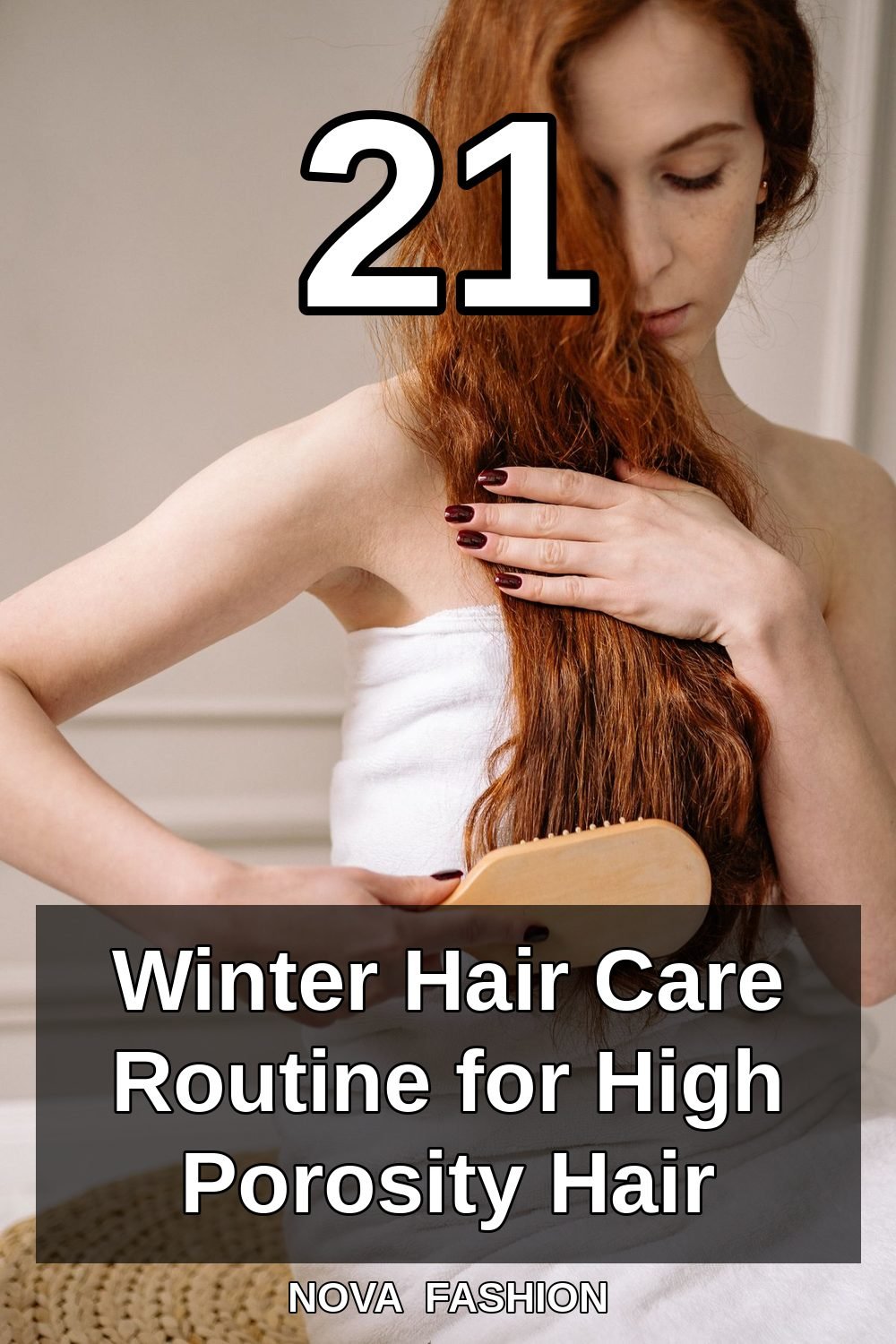
Save this look for later on Pinterest so you can find the full 21-step routine whenever you need it.

Want to make your own pin for this routine? Try the free Pinterest Caption & Pin Generator on Nova Fashion — it writes a caption for your pin in seconds.
Your Turn: Give Your High Porosity Hair the Winter Care It Deserves
High porosity hair is not difficult hair — it is thirsty hair, and winter just makes it thirstier. Start with the pre-poo and the deep conditioner this week, add the LOC method on your next wash day, and protect your curls at night with satin. Small, steady steps beat a shelf full of products every time. By spring, your curls will be softer, stronger, and shinier than they have been in years — and you will wonder why you ever dreaded winter wash day. Follow Nova Fashion on Pinterest for more seasonal hair routines, and save this one so it is there when the cold weather returns.
One more thing worth remembering: patch-test any new product before you commit to it. High porosity hair absorbs everything quickly, including ingredients that might irritate your scalp, so try a new mask or treatment on a small section first and wait a day. Keep your routine simple for the first month — a gentle shampoo, a rich deep conditioner, a leave-in, an oil, and a butter are genuinely all you need. Once those five products are working for you, then you can experiment with one new addition at a time, so you always know what is helping and what is not. And if your hair ever feels worse instead of better, go back to basics for a week: wash gently, deep condition, seal with oil, and sleep on satin. Nine times out of ten, that reset is all it takes to get your curls back on track.