
French braid hairstyles for women spring — the French braid is spring’s prettiest practical hairstyle: neat, romantic, and done in minutes. If you have ever wanted a hairstyle that keeps your hair tidy on a breezy day, looks beautiful from every angle, and still feels soft and feminine, the French braid is the answer. It is the braid most of us learned first, and it is the one we come back to every spring, because it works with the season’s lighter clothes, brighter days, and outdoor plans.
This guide brings together 21 French braid hairstyles for women, from the classic single braid to double braids, half-up styles, and braided updos. Every style comes with beginner-friendly steps, honest advice about fixing the mistakes everyone makes — loose pieces, uneven sections, a braid that drifts to one side — and ideas for accessories that make a simple braid feel special. You do not need long hair, perfect coordination, or a salon. You need clean-ish hair, a brush, a few elastics, and a little patience with your own hands.
Spring is the ideal season to practise braiding. The air is warmer, so you are not fighting static the way you do in winter, and a braid keeps your hair out of the way when the wind picks up. A French braid also ages beautifully through the day: it starts neat in the morning, softens into something romantic by the afternoon, and still looks good when you take it out in the evening and find gentle waves underneath. That is three hairstyles for the effort of one, which is a very spring kind of bargain.

Classic French Braid Basics
Before the fancy variations, let us get the classic right. A French braid is simply a three-strand braid that picks up new hair as it travels down the head. That picking-up is what makes it lie flat against the head instead of hanging loose, and it is also the part that worries beginners. The good news is that your hands learn the rhythm quickly: cross, pick up, cross, pick up. After a few attempts, you will not need to think about it at all, and that is when braiding becomes relaxing instead of stressful.
Work with hair that is brushed smooth and slightly textured. Freshly washed hair is slippery and the braid will slide apart, so second-day hair is ideal. If you have just washed it, a little dry shampoo or texturising spray at the roots will help enormously. Sit somewhere comfortable, keep a mirror in front of you for the start, and accept that your first braid may not be perfect. Nobody’s is. The second one will be better, and the fifth one will look like you have been braiding for years.
The Classic French Braid Step by Step
Start at the crown with a small section of hair, and divide it into three equal strands. Cross the right strand over the middle, then the left strand over the new middle. Now, each time you cross a side strand over, pick up a small piece of loose hair from that side and add it to the strand before you cross. Keep the sections even and the tension gentle — not tight, not loose, just firm enough to hold. When you run out of hair to pick up, finish with a regular three-strand braid and secure the end with a small elastic.
The most common beginner mistake is taking uneven sections, which makes the braid wander. To avoid it, use the tip of a comb or your little finger to section the hair, and take the same amount from each side every time. If the braid starts drifting, stop, look in the mirror, and gently guide it back to the centre before you continue. A braid that is a little off-centre still looks lovely, so do not undo the whole thing for a small wobble — finish it, wear it, and try again tomorrow.
Starting Your Braid at the Crown
Where you start the braid changes the whole look. Starting high at the crown gives a dramatic, swept-back effect that shows off your face and works beautifully for spring events. Starting lower, at the back of the head, gives a softer, more relaxed braid that is perfect for everyday wear. For your first attempts, start at the crown, because you can see what your hands are doing in the mirror, and the braid will feel more secure as it travels down.
Whatever height you choose, begin with a clean, even section. Brush the hair at the crown smooth, and make sure there are no tangles hiding underneath, because a tangle will catch halfway down and spoil the rhythm. If your hair is layered, start the braid a little lower, where the layers are long enough to reach, and let the shorter pieces at the front frame your face instead of forcing them into the braid.

Keeping Sections Even
Even sections are the secret to a French braid that looks polished. The easiest way to keep them even is to slow down. Braiding is not a race, and the few extra seconds it takes to pick up a neat section are worth it. Use your fingers as a guide: the section you pick up should be about the width of two fingers, and it should be the same on both sides. If one side starts to look thicker than the other, take a slightly larger section from the thinner side next time to balance it out.
It also helps to keep your hands close to your head. When your hands drift away from the scalp, the braid loosens and the sections become uneven. Keep your elbows down, your hands near the head, and the tension steady. After a few minutes, your arms may ache — that is normal, and it is why braiding your own hair gets easier with practice. Take a short break, shake your arms out, and carry on. Your braid will forgive a pause far more easily than it forgives rushing.
French Braid Updos
Once you can French braid, an updo is only a few pins away. A braid that ends in a bun, a braid that wraps into a chignon, or a braid that circles the head — each one takes the neatness of the French braid and turns it into a finished style. These updos are the ones to reach for in spring, when you want your hair completely up and out of the way but still want it to look romantic and special. For more braid inspiration, Nova Fashion’s 19 winter braid hairstyles show how the same braiding skills work in every season.
French Braid Into a Low Bun
French braid from the crown down to the nape, then gather the remaining hair — braid and all — into a low bun and pin it. The braid gives the top of the style beautiful texture, while the bun keeps the ends tidy. It is one of the most practical French braid hairstyles for women in spring, because the braid holds the front of your hair secure all day while the bun stays cool and comfortable. Finish by gently pulling at the braid to widen it, and pull out two soft strands at the temples.
This style suits a spring wedding, a work day, or a long afternoon outdoors, because it does not need adjusting. If your hair is fine, backcomb the ponytail lightly before you coil it, and the bun will look fuller. If your hair is thick, split the remaining hair into two sections and coil them one after the other so the bun sits flat. A small pearl pin or a simple gold clip at the side of the bun is all the decoration it needs.
The Braided Chignon
The braided chignon is the elegant cousin of the braid-into-a-bun. Instead of braiding straight down the back, braid diagonally from one temple towards the opposite side of the nape, then coil the end into a low chignon. The diagonal line is flattering and a little unexpected, and it gives the style a soft, swept feeling that suits spring dresses and open necklines. It is a lovely choice for a formal spring occasion, because it looks intricate without being difficult.
Keep the braid loose and soft, and do not worry if a few strands escape at the front — they are part of the look. A braided chignon works best on hair that reaches at least the shoulders, and it is a kind style for layered hair, because the braid catches the layers as it travels and the chignon hides the ends. Add a sprig of blossom or a delicate hair vine, and the style is ready for a wedding.
French Braid With a Twist
For a modern twist, French braid only one side of your head, from the temple down to the nape, and leave the rest of your hair in a low bun or a loose ponytail. The single braid becomes a beautiful detail, like a piece of jewellery for your hair, while the rest of the style stays simple. This is a wonderful way to wear a French braid if you are still learning, because you only have to braid one side, and the other side can be as simple as you like.
This asymmetric style is also very flattering, because it creates a diagonal line across the head that draws the eye. Wear the braid on the side where your part falls, and keep the bun low and soft. It is a fresh, spring-appropriate look for a day out, a lunch with friends, or any occasion when you want your hair to look considered without looking overdone.
Half-Up French Braids
Half-up French braids are the perfect compromise: the neatness of a braid at the top, and the freedom of loose hair underneath. They are the styles to choose when you love your length and do not want to hide it, but you still want your hair out of your face. In spring, half-up braids are everywhere, because they work with a breeze, they suit the season’s softer clothes, and they take only a few minutes.

Half-Up French Braid Crown
Make two short French braids, one from each temple, and join them at the back of your head. The result is a braided crown across the top of your head, with the rest of your hair falling loose underneath. It is romantic, it is pretty, and it is one of the easiest half-up styles to learn, because each braid is short and you can see what you are doing. For a spring version, keep the braids soft and pull gently at their edges so they look full and relaxed.
This crown works on almost every hair length, from shoulder-length to very long, and it is a kind style for wavy hair, because the waves in the loose lengths contrast beautifully with the neat braids. Add a few small flowers or a ribbon at the join, and it becomes a lovely style for a spring party or a garden wedding.
French Braid With Loose Waves
Start a French braid at the crown and braid only halfway down, securing it with a small elastic and letting the rest of your hair fall in loose waves. The contrast between the neat braid and the soft waves is what makes this style so pretty. It is the braid to choose when you want to look polished but not formal, and it works beautifully with the natural wave that spring humidity gives so many of us.
If your hair is straight, add a few loose curls to the ends with a large-barrel iron before you braid, and the waves will hold their shape. If your hair is already wavy, simply brush it through and let it do its own thing. Keep the braid a little loose, and pull out a strand or two at the front to frame your face. This is a gentle, everyday spring style that takes five minutes and looks like it took much longer.

Half-Up Braid for a Spring Day
For the simplest half-up braid of all, take a section of hair from the crown, French braid it for just a few crossings, and pin it at the back. That is it. The small braid acts like a clip, holding the front sections back, while the rest of your hair stays loose. It is the style to reach for on a busy spring morning, when you want to look put together but you only have three minutes.
Because the braid is small, it is also the best one to practise on. If it goes wrong, you have only lost a minute, and you can try again. Once you are confident with a small half-up braid, the longer braids in this guide will feel much easier, because your hands will already know the movements.
Double French Braids
Double French braids are the playful, practical side of French braiding. Two braids, one on each side of the head, keep your hair completely secure, and they look wonderful with spring’s casual clothes — denim jackets, sundresses, and trainers. They are also the braid to choose for a long day outdoors, a festival, or a workout, because they distribute the hair evenly and do not pull. If you can French braid one side, you can braid both; the second braid is simply a mirror of the first.

Double French Braids Step by Step
Part your hair straight down the middle, from the forehead to the nape, and clip one side out of the way. French braid the free side from the front hairline backwards, picking up hair as you go, and secure the end with a small elastic. Repeat on the other side, trying to match the size and tension of the first braid. When both braids are done, gently pull at their edges to make them look fuller, and you are finished. The hardest part is the centre part — use the handle of a comb to make it straight, and the rest will follow.
For a spring look, keep the braids soft rather than tight, and let a few strands frame your face. A double braid that is pulled apart slightly looks romantic and relaxed, while a very tight double braid looks sporty. Both are lovely — choose the one that suits your day. If you want to compare the French braid with its closest cousin, Nova Fashion’s Dutch braid hairstyles for winter women use the same parting and picking-up technique, with the braid sitting on top of the hair for a bolder, raised effect.
French Braids Into Space Buns
For a fun spring look, French braid each side of your head upwards, towards the crown, and coil each braid into a small bun on top. The result is double braids that finish in two little space buns — a playful style that is perfect for a festival, a picnic, or a day when you simply want to have fun with your hair. The braids keep the sides neat, while the buns keep the ends out of the way.
This style works best on hair that is at least shoulder-length, and it is a wonderful way to use up the ends of a braid that would otherwise hang loose. Keep the buns small and soft, and pin them well, because they sit high on the head and will be noticed. A pair of small, matching clips or a touch of glitter at the buns makes the style feel festive without trying too hard.
French Braids for Short and Medium Hair
French braids are not only for long hair. Short and medium hair can be French braided beautifully, as long as you adjust the technique: smaller sections, a lower starting point, and a willingness to let short layers do their own thing at the front. The styles below are made for the lengths most of us actually have in spring.

French Braids for Short Hair
On short hair, a French braid becomes a beautiful detail rather than a full style. Braid a short section from the temple back towards the crown, pin it in place, and let the rest of your hair fall as it likes. The braid acts like a headband, holding the front sections back and adding texture. It is a lovely way to grow out a short cut, because the braid catches the pieces that would otherwise fall into your eyes.
Use small sections and a light texturising spray, because short hair is slippery and a braid can slide out. Secure the end with a tiny elastic and a pin, and do not worry if the braid is short — a short braid is still a braid, and it still looks intentional and pretty. For more short-hair ideas, the bubble braid hairstyles on Nova Fashion are another playful option that works on shorter lengths.
French Braids for Medium Hair
Medium hair is the sweet spot for French braids. It is long enough to braid fully, from the crown to the nape, and short enough that the braid does not take forever. A single French braid on medium hair sits neatly at the back of the head, and a double braid looks full and balanced. If your hair is layered, start the braid a little lower, where the layers are long enough to reach, and let the shorter front pieces frame your face.
For a spring day, try a French braid that finishes in a low, loose bun, or a half-up braid with the rest of the hair worn wavy. Medium hair holds a braid well, because it has enough weight to stay put without pulling, and enough texture to grip the pins. It is the length that makes French braiding feel easy, which is why so many of the styles in this guide work best on medium hair.
Fixing Loose Pieces and Uneven Sections
Every braider, no matter how experienced, has days when pieces come loose and sections go uneven. The fix is almost always the same: do not undo the braid. Instead, take the loose piece, twist it gently, and pin it into the braid with a bobby pin, hiding the pin underneath a loop of the braid. If a section is uneven, pull gently at the loops on the thinner side to widen them, and the braid will look balanced.
For pieces that keep escaping at the front, a little smoothing cream on your fingertips will press them back without making the hair look stiff. And if the whole braid feels lopsided, remember that a French braid softens as you wear it — the style that looks slightly uneven in the mirror at 8am often looks perfectly relaxed by 10am. Braiding is a skill, and like every skill, it improves with practice, not with perfectionism.
Frequently Asked Questions About French Braid Hairstyles
How long does it take to learn a French braid? Most people can do a basic French braid after three or four attempts, and feel confident after a week of practising a few minutes a day. Start with a half-up braid, which is shorter and easier, and work up to a full braid.
Why does my French braid keep coming loose? Freshly washed hair is usually the cause — it is too slippery. Try second-day hair, or add dry shampoo or texturising spray at the roots. Keeping your hands close to your head and the tension steady also helps.
Can I French braid my own hair if it is layered? Yes. Start the braid lower, where the layers are long enough, and let the shorter pieces at the front frame your face. A little smoothing cream will help the shorter pieces stay in the braid.
What accessories work best with French braids? Small elastics that match your hair colour, a few bobby pins, and one decorative piece — a ribbon, a pearl pin, or a small flower. Keep it simple, and let the braid be the star.


Save this for later: Pin the image below to keep these 21 French braid hairstyles for women handy all spring.
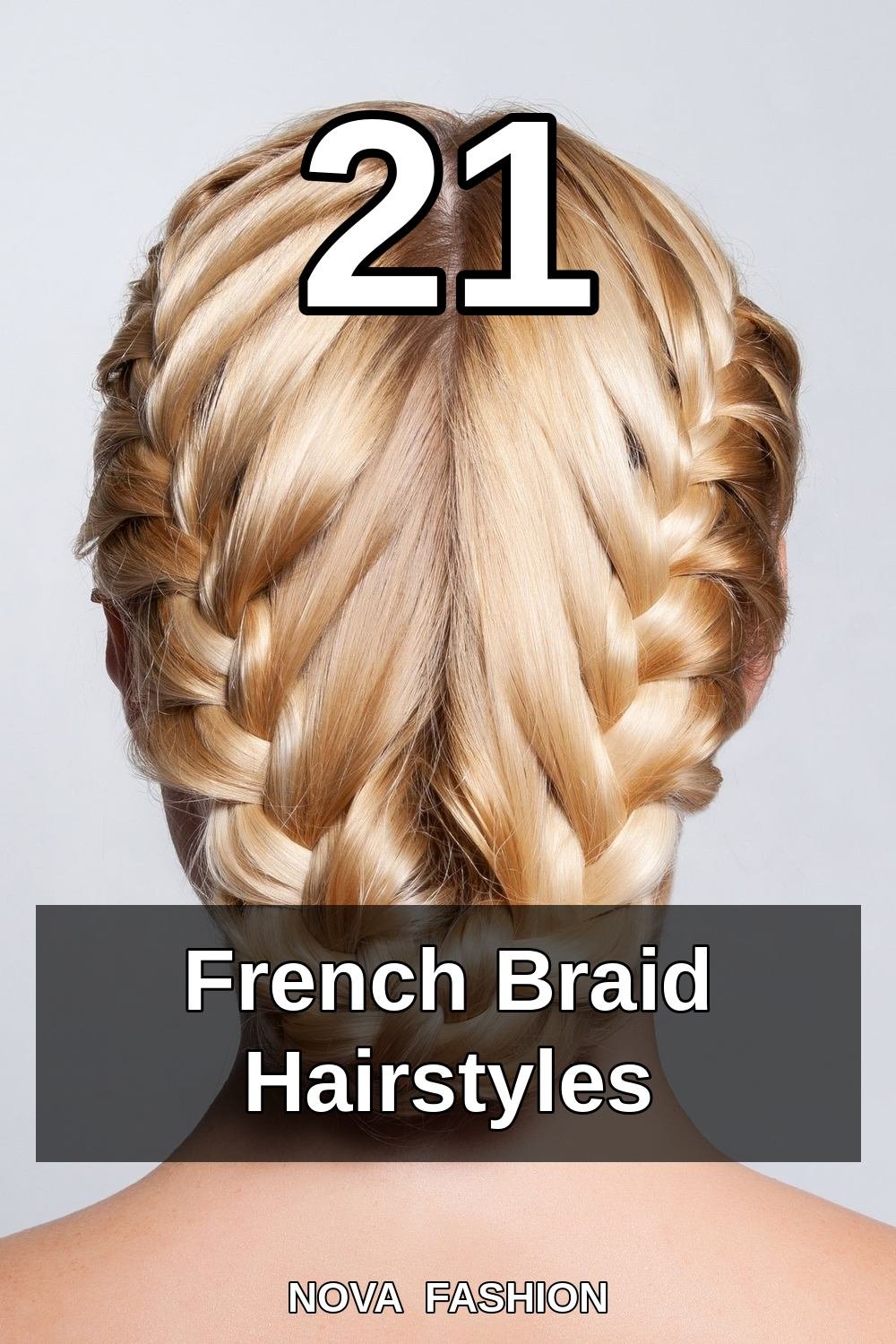
Save this French braid idea on Pinterest

Want a caption for your own pin? Try Nova Fashion’s free Pinterest Caption & Pin Generator to create a caption for your French braid pin in seconds.
The French braid is spring’s prettiest practical hairstyle, and now it is yours to practise. Choose one braid from this guide — just one — and try it this week. Start with a half-up braid if you are new, or a double braid if you are feeling brave, and give your hands time to learn the rhythm. Before long you will be braiding without thinking, and your spring hair will thank you for it. Which braid will you practise first? Tell us in the comments, and follow Nova Fashion on Pinterest for more spring hair ideas, easy braids, and fresh seasonal inspiration all year long.